


Education
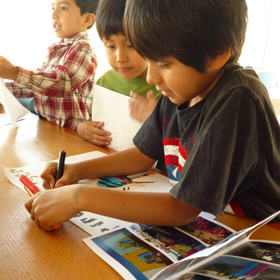 The future of neighborhoods eager to attract and retain a diverse blend of residents is closely tied to the educational opportunities that are available to the families who live there. At LISC, we believe that all students should have access to great educational resources regardless of where they live. That’s why LISC continues to invest in efforts throughout the city to improve educational opportunities for Indianapolis students.
Attaining sufficient facilities is the biggest hurdle for new and existing public charter schools. So LISC established the Educational Facilities Financing Center in 2003 to undertake a three-pronged approach to addressing this challenge nationally. And this has helped Indianapolis become a national leader in charter schools, with LISC Indianapolis providing technical support and financing to more then 20 of these schools in the Indianapolis area. To find out more about LISC’s charter school facility financing, click here.
More recently, LISC has expanded its work in education beyond facility development to include programs that more directly impact learning in the form of out-of-school time (OST) programs in collaboration with community groups and schools. We have supported after-school enrichment activities at community centers, student visits to college campuses, community school coordinators in schools, and a neighborhood education taskforce.
Together, these activities have helped to improve educational opportunities in underserved communities and have built the foundation for continued collaboration between community development stakeholders and local schools.
 Brighter Kids. Brighter Future.
The Children’s Museum of Indianapolis is expanding its scope to reach more kids with out-of-school-time programs—a need identified by a study made possible by funding from LISC. See how the Children’s Museum is bringing more opportunities for learning to underserved local kids here.
Success Story: Exploding Chocolate and Other Great Ideas
Kimberly Guerrero heard about Second Story in her third-grade class at SENSE, the charter elementary school on Indianapolis’s near southeast side. She thought it would be a good idea to work on her writing. “I’m going to have to write a lot in medical school,”she said.
Second Story can help. The grassroots program was created to foster student enthusiasm for creative writing and help students develop critical thinking skills. It’s an important component of the Southeast Quality-of-Life Plan that seeks to provide educational options for neighborhood kids.
For the past couple of years, Second Story has developed in school and after-school programs and writing summer camps for kids across Indianapolis. In 2009, with a seed grant from LISC and support from State Farm, Second Story launched its first Fountain Square-specific after-school program at the Wheeler Arts Community. Each week, a team of 10 volunteers — writers, educators, professionals, and students — worked with 20 elementary school neighborhood kids.
Among them was Kimberly. “I wrote stories about my sister (Angie, age 1) and brother (Carlos, age 6). They’re both nice, but sometimes they give me problems.”
Kimberly said writing helps her with school and makes her feel proud of her work. “We wrote books, and we shared them with each other. We wrote about our summer vacations. And w wrote about a restaurant we made up. My restaurant had a fountain cake with chocolate that exploded everywhere. I love to write funny things. It’s hard sometimes, but when you getstarted, it’s a lot of fun.”
Second Story also is also helping connect writers and educators with kids at many levels. Students from Butler University and the University of Indianapolis have served as program volunteers. Last summer, Second Story collaborated with Y-Press, an organization that helps develop young journalists, on a writing program that paired high school students with elementary school kids.
And Kimberly isn’t done with her writing. “I’m planning a new story right now,” she said.
For more information, please contact:
Sara VanSlambrook
Senior Program Officer
[email protected]
317-454-8493
Educational Programming
Rachel McIntosh
Senior Program Officer
317-454-8488
[email protected]
Charter Schools
For additional information and more resources, check out our Program Partners under Education.